
How to Reduce SOC 2 Compliance Costs for SaaS Companies (Without Cutting Corners)
Your CTO ran the numbers last week. Your sales team is waiting on a SOC 2 report to close the enterprise deal. And every quote you've gotten comes in somewhere between $30,000 and $90,000, depending on who you ask. The spread is not a mistake. It is the point.
SOC 2 costs vary that widely because the real cost is not the auditor's invoice. It is every decision you make in the six months leading up to the audit.
Most SaaS companies overspend by 30 to 50 percent on things that never needed to be bought, tools that were oversold to them, and consultant hours that replaced work their own team could have done faster.
This post is not about cutting corners. This is about knowing where the money actually goes, which line items are negotiable, and which are fixed. If you know that, you can cut tens of thousands of dollars off your first SOC 2 without touching the quality of your program.
What SOC 2 actually costs in 2026
Let's start with honest numbers. For a SaaS company under 100 employees, a first-year SOC 2 Type II typically breaks down like this:
Fixed-range costs (you cannot negotiate these away):
Auditor fee: $8,000 to $25,000 for a specialist CPA firm. Big Four quotes will come in at $40,000 to $80,000+, and for most SaaS companies at your stage, that premium buys you nothing your customers care about.
Penetration test (often required by your customers, sometimes by your auditor): $5,000 to $15,000.
GRC platform (Vanta, Drata, Secureframe): $7,000 to $30,000 per year, depending on which you choose and how hard you negotiate.
Variable costs (this is where companies overspend):
Readiness assessment: $0 if done in-house, up to $25,000 if a large consulting firm does it.
Consultant or advisory fees: $15,000 to $50,000 is typical. The range is enormous and the value often is not.
Remediation (closing gaps found in readiness): $5,000 to $85,000+. This line item is where surprise bills live.
Internal team time: 200 to 600 hours for a first-time audit. At a $100/hr blended rate, that is $20,000 to $60,000 of opportunity cost.
Security tooling (SSO, MDM, logging): $6,000 to $15,000 per year in new subscriptions.
Employee security awareness training: $500 to $5,000 per year.
Add it all up and a first-year SOC 2 for a 25-person SaaS company typically lands between $35,000 and $80,000 all in. Not $12,000. Not $150,000. Somewhere in that range, depending on how well you make the six decisions below.
The 6 decisions that determine your total cost
1. Type I or Type II (and whether to skip Type I)
Type I is a point-in-time snapshot. Type II is a 3 to 12 month observation of the same controls operating consistently. Type II costs 30 to 50 percent more on the audit line alone, and most enterprise buyers in 2026 no longer accept Type I as sufficient proof.
Here is what most cost posts will not tell you: doing Type I first and then Type II often costs more in total than going straight to Type II. You run two audits, pay two sets of preparation costs, and still end up in the same place. Do Type I only if you have a specific enterprise deal on the line that will accept it. Otherwise go straight to Type II.
Potential savings by skipping an unnecessary Type I: $8,000 to $15,000.
2. Scope (accurate scope, not minimal scope)
This is where most cost-cutting advice goes sideways.
A SOC 2 report is built on two scoping decisions. The first is which Trust Services Criteria (TSC) to include: Security (always required), Availability, Confidentiality, Processing Integrity, and Privacy. The second, and the one almost nobody talks about, is the system boundary: which products, environments, locations, personnel, supporting systems, and vendors are actually being examined.
Most pricing guides tell you to strip TSCs out to save money. That is the wrong lens. SOC 2 is not a checklist. It is an attestation to customers, partners, and investors that your business operates with the controls it says it operates with. When you cut a TSC out to reduce cost, you are not saving money. You are deferring a conversation with the next enterprise customer who asks about it and now wants a new audit or a bridge letter to cover the gap.
The right question is not "what can I cut to spend less." It is "what does my business actually do today, and what is the smallest accurate boundary that reflects that."
Scope for where the business is now.
A cloud-native SaaS running in AWS with a fully remote team has a very different scope than a healthtech company with a clinical office and a backup data center in a third-party colocation facility. The first has essentially no physical access controls to document, because AWS is carved out as a subservice organization. The second has a physical boundary in scope, which means locks, badge systems, camera coverage, visitor logs, and temperature monitoring all become audit evidence.
Your system boundary should reflect reality, not aspiration. If you have one product in production and another in beta with three customers, scope in the production product and decide on the beta based on whether those customers are relying on compliance to use it.
The same logic applies to Trust Services Criteria. Platforms like Vanta and Drata include the full framework built in, which is then scoped down to the controls that apply to your business. That is not the same as "adding TSCs one at a time to save money." You are not buying criteria à la carte. You are defining a system description that accurately describes your business, and the applicable criteria follow from that description.
Review scope annually, not mid-audit.
SOC 2 is a living program, not a one-time certification. Every year you renew, your scope should be reviewed against how the business has actually changed. New product line in production? New office? New subservice provider? Acquired a company? Each has a scope implication, and the time to address it is before the next observation period, not during the audit when an assessor finds the gap.
A mature program updates the system description, risk assessment, and applicable controls as part of annual planning. Scope changes are budgeted, communicated to the auditor in advance, and baked into the evidence collection plan. Scrambling to document a new office three weeks into an audit is the reason SOC 2 engagements go over budget.
Build compliance into business changes as they happen.
The single most expensive scoping mistake is waiting to think about compliance until the audit starts. A company opens a new office, furnishes it, signs the lease, and then realizes six months later during audit prep that there are no badge readers, no camera coverage of the server closet, and no visitor log at reception. Now the choice is either carve the office out of scope, which tells customers your compliance program does not cover where your employees actually work, or retrofit physical controls into a finished space, which is expensive and disruptive.
The same pattern shows up with new vendors, new product lines, new customer integrations, and geographic expansion. Every one of these is cheaper to handle compliantly at the moment the decision is made than to retrofit later.
A few real scoping examples:
A 40-person SaaS running entirely in AWS, fully remote team. Physical controls scope is minimal. AWS carved out as a subservice organization. System description focuses on logical access, change management, and vendor management.
A fintech processing payment transactions, remote team, office in one city for operations. Processing Integrity is clearly in scope. The office is in scope because operations staff handle sensitive data there. Physical controls documented for that one location.
A healthtech expanding from one product to two. Original product is audit-ready. Second product launches in six months. Decision: include only the first product this year, plan the system description update now so the second product is ready for next year's observation period.
The pattern in all three: scope accurately describes the business right now, reviewed annually as it changes, with compliance decisions built into business decisions as they happen.
Potential savings by scoping accurately: Avoiding one mid-audit scope scramble typically saves $10,000 to $25,000 in rework and auditor hours. The bigger savings is what you do not spend on retrofitted controls in spaces, systems, or products that should never have been in scope in the first place.
3. Auditor selection
There are three tiers of SOC 2 auditors, and the price gap between them is roughly 3x for the same report.
Boutique and specialist CPA firms ($8,000 to $25,000 for Type II): Firms like KirkpatrickPrice, Prescient Security, Schellman, and A-LIGN. These are who most SaaS companies should use. The report they produce is functionally identical to a Big Four report from the perspective of your customers.
Regional CPA firms ($20,000 to $55,000): A middle tier that is usually overkill for SaaS but sometimes makes sense for multi-framework audits.
Big Four ($40,000 to $100,000+): Deloitte, PwC, EY, KPMG. Only worth the premium if you are on an IPO track, in a heavily regulated vertical, or have a customer who specifically requires it. Most SaaS companies never need this tier.
Your customers are not going to reject your report because KirkpatrickPrice signed it instead of Deloitte. Ask. If nobody is requiring a Big Four name, do not pay for one.
Potential savings by choosing the right tier: $30,000 to $60,000.
4. Platform selection
Vanta, Drata, and Secureframe all produce functionally equivalent SOC 2 outcomes. Their pricing is also functionally equivalent once you negotiate. What matters is which one fits your existing stack, your audit timeline, and your vendor risk posture.
A few decision points worth naming:
If you are pursuing HITRUST in the future or expect to run 30+ frameworks long-term, Vanta has the authorized HITRUST partnership.
If hourly (vs. daily) control monitoring matters to your audit obligations, Vanta tests more frequently.
If vendor risk management is a significant piece of your program, Vanta's VRM portal is more built-out.
If price is the only factor, Drata negotiates more aggressively against Vanta and Secureframe comes in cheapest at street pricing.
Whichever you choose, negotiate. List prices are inflated 30 to 50 percent. Competitive quotes from the other platforms will usually drop your first-year price by $5,000 to $15,000. Lock in multi-year pricing if you can. Vanta customers commonly report 25 to 40 percent renewal price increases.
Potential savings by negotiating platform pricing: $5,000 to $20,000 in year one.
5. Readiness approach
This is where most companies either save the most money or lose the most money, and the decision is almost always made on autopilot.
Four common paths:
Pure DIY. You use the platform's templated policies, collect evidence yourself, and hope you got it right.
Direct cost: $0 extra. Hidden cost: 400 to 600 hours of your team's time, and a real risk of costly audit rework. Not recommended for first-time programs.
Full-service consulting firm. A traditional GRC consulting firm runs the whole readiness and prep engagement.
Cost: $30,000 to $80,000. This is usually overkill for a first SOC 2.
Platform-included advisory. The GRC platform provides generic advisory hours as part of your subscription.
Cost: included. Quality: highly variable. Usually fine for straightforward programs and insufficient when you hit edge cases.
Fractional compliance principal. A dedicated compliance lead who manages your program on retainer, scoped to the hours you actually need.
Cost: $15,000 to $35,000 for a first SOC 2, depending on starting posture.
The fractional model is the newer option and the one most SaaS companies in the 10 to 100 employee range are quietly shifting toward, because it gets you a named owner without the overhead of a full-service firm.
Potential savings by right-sizing readiness: $10,000 to $45,000.
6. Pre-audit gap assessment
This is the smallest line item on this list and the one with the highest ROI.
A gap assessment is a structured, written review of your current posture against the controls your chosen framework requires. It typically runs 10 hours of focused work and produces a findings report that tells you exactly what to fix, in what order, with what evidence.
Why does this save you money? Because every control gap you find before the audit costs a fraction of what the same gap costs during the audit. A remediation cycle during an active audit engagement adds $5,000 to $15,000 to your auditor fees, and that is before you count the deal delay on the enterprise contract waiting for your report.
This is the single highest-leverage expense in the entire SOC 2 budget. It is also the one most startups skip, because it feels like "extra" work. It is not. It is the work that keeps every other line item from ballooning.
What you should actually budget
Putting it all together, here is a realistic budget for a 25-person cloud-based SaaS company pursuing a first Type II SOC 2 in 2026. This assumes a full Trust Services Criteria scope with an accurately defined system boundary: AWS carved out as a subservice organization, remote team, single production product, no physical office in scope.
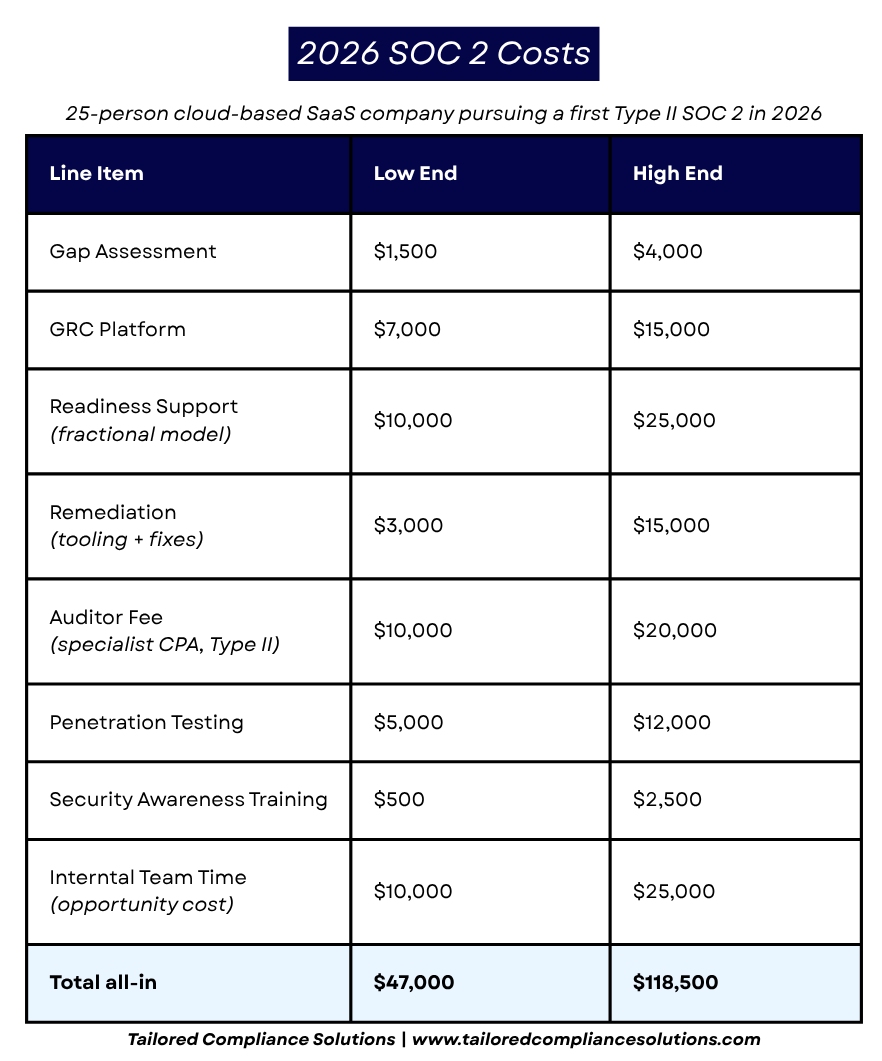
⚠️ If your quote is materially higher than the top of that range, something is either out of scope or overpriced. Ask.
What not to cut
A few line items where trying to save money costs you more:
Do not skip the pen test if your customers are likely to ask for one. Paying $8,000 for a pen test now is cheaper than delaying a $250,000 enterprise deal by two months.
Do not pick an auditor based purely on price. A $5,000 quote from an unknown firm often signals either inexperience or a rushed engagement, and your report carries the auditor's reputation with your customers.
Do not DIY your first SOC 2 if you have never run a compliance program. The hours you spend figuring out control language and evidence requirements are hours your engineering team is not building product.
Do not skip the readiness gap assessment. This is the line item with the highest return on investment in the entire budget.
How TCS approaches this
At Tailored Compliance Solutions, most first-time SOC 2 engagements start with a scoped gap assessment. It runs about 10 hours of our time and produces a written findings report that maps every gap to the control it affects and the evidence you will need to close it. That report is the foundation for everything downstream, and it is what keeps the rest of the engagement from drifting into surprise costs.
For SaaS companies that want a named compliance owner without hiring full-time, we offer fractional compliance principal engagements on monthly retainer. No package bundles, no multi-year lock-ins, no minimums beyond the first assessment.
We are also partners with both Vanta and Drata, which means we can tell you which platform fits your program without a vendor relationship pulling us one direction. Most firms can only guide their clients on one or the other. Bringing TCS in early allows us to set the groundwork for your future compliance programs or CISO hand-offs for ongoing scalability.
If you are scoping your first SOC 2 and the quotes you are seeing do not match the ranges in this post, that is worth a conversation. We offer fully scoped gap assessments as a fixed-hour engagement with no obligation to continue afterward. Book a gap assessment or see our full service list.
