
How to Choose SOC 2 Compliance Software for a SaaS Startup: Vanta vs Drata
Most Vanta vs Drata comparisons are written by companies selling a third platform, and it shows. You read three of them and walk away more confused than when you started, because none of them will commit to a recommendation.
This one is different for one reason: Tailored Compliance Solutions is partnered with both platforms. We implement on Vanta. We implement on Drata. And because we have experience in both, we can tell you what neither vendor's website will: for most SaaS startups, the two platforms produce functionally equivalent SOC 2 outcomes. The right choice comes down to a handful of specific factors about your situation, not which platform is "better” but which is “better for you.”
This post walks through those factors in order, gives you a decision flow you can apply to your own company, and a side-by-side comparison of the things that actually differ in 2026. We will be objective about where each platform wins, including the ones we use less often.
The honest starting point: they are more alike than different
Before we get into differences, here is what is true about both Vanta and Drata for a SaaS startup in 2026:
Both automate evidence collection across your cloud infrastructure, identity provider, HR system, and development tools.
Both continuously monitor controls and flag drift.
Both support SOC 2, ISO 27001, HIPAA, PCI DSS, GDPR, and other common frameworks.
Both produce a report your auditor will accept. Your choice of platform does not limit your auditor options.
Both require a sales call before you see real pricing.
Both offer annual contracts starting around $7,500 to $15,000 for SOC 2-only at small company scale, with multi-framework packages running $40,000 to $80,000+ for enterprises.
Both include aggressive renewal pricing increases after year one.
If your decision is "SOC 2 automation for a 25-person SaaS running in AWS," either platform will get you there. The differences matter in specific situations, which is what the rest of this post is for.
The decision flow
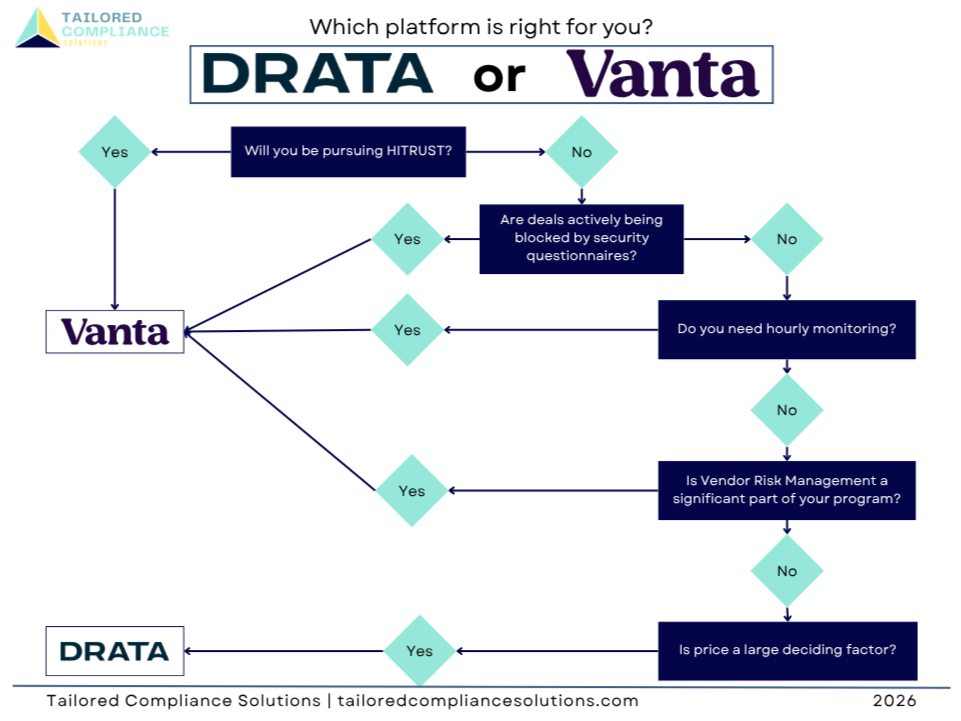
Here is the sequence of questions we walk clients through when they ask us which platform to choose. Work through them in order, stop at the first one that returns a strong signal, and you will usually have your answer.
Make it stand out
Whatever it is, the way you tell your story online can make all the difference.
Question 1: Are you pursuing HITRUST, or do you expect to run 30+ frameworks long-term?
If yes → Recommend Vanta. Vanta is the only authorized HITRUST partner in this category. If HITRUST is in your roadmap, this decision is made.
If no → Continue.
Question 2: Are deals actively blocked by security questionnaires right now?
If yes → Lean Vanta. Vanta's Trust Center and AI-powered questionnaire automation is more mature, with a reported 95 percent accuracy rate. If clearing questionnaires is a near-term business priority, this is worth something.
If no → Continue.
Question 3: Do you need hourly control monitoring or have continuous audit obligations?
If yes → Recommend Vanta. Vanta runs control tests hourly. Drata runs them daily. For most companies, daily is fine. If you have a specific reason to need faster cadence (regulated industry, specific customer contract language, or continuous compliance obligations), this matters.
If no → Continue.
Question 4: Is vendor risk management a significant part of your compliance program?
If yes → Lean Vanta. Vanta's VRM portal is more built out. Drata has VRM but it is narrower in scope.
If no or minimal → Continue.
Question 5: Are you price-sensitive, especially on multi-framework or per-framework add-on costs?
If yes → Drata worth considering. Drata's per-framework add-on pricing is roughly $1,500 compared to Vanta's $5,000. For a company planning SOC 2 + ISO 27001 + HIPAA in year one, that is a $10,000+ annual difference. Drata also tends to discount more aggressively against Vanta on initial contracts.
If value-first and price is secondary → Continue.
That is the flow. Most companies will hit a strong signal by question 3 or 4.
Side-by-side: where they actually differ in 2026
For the factors that matter for a SaaS startup choice:
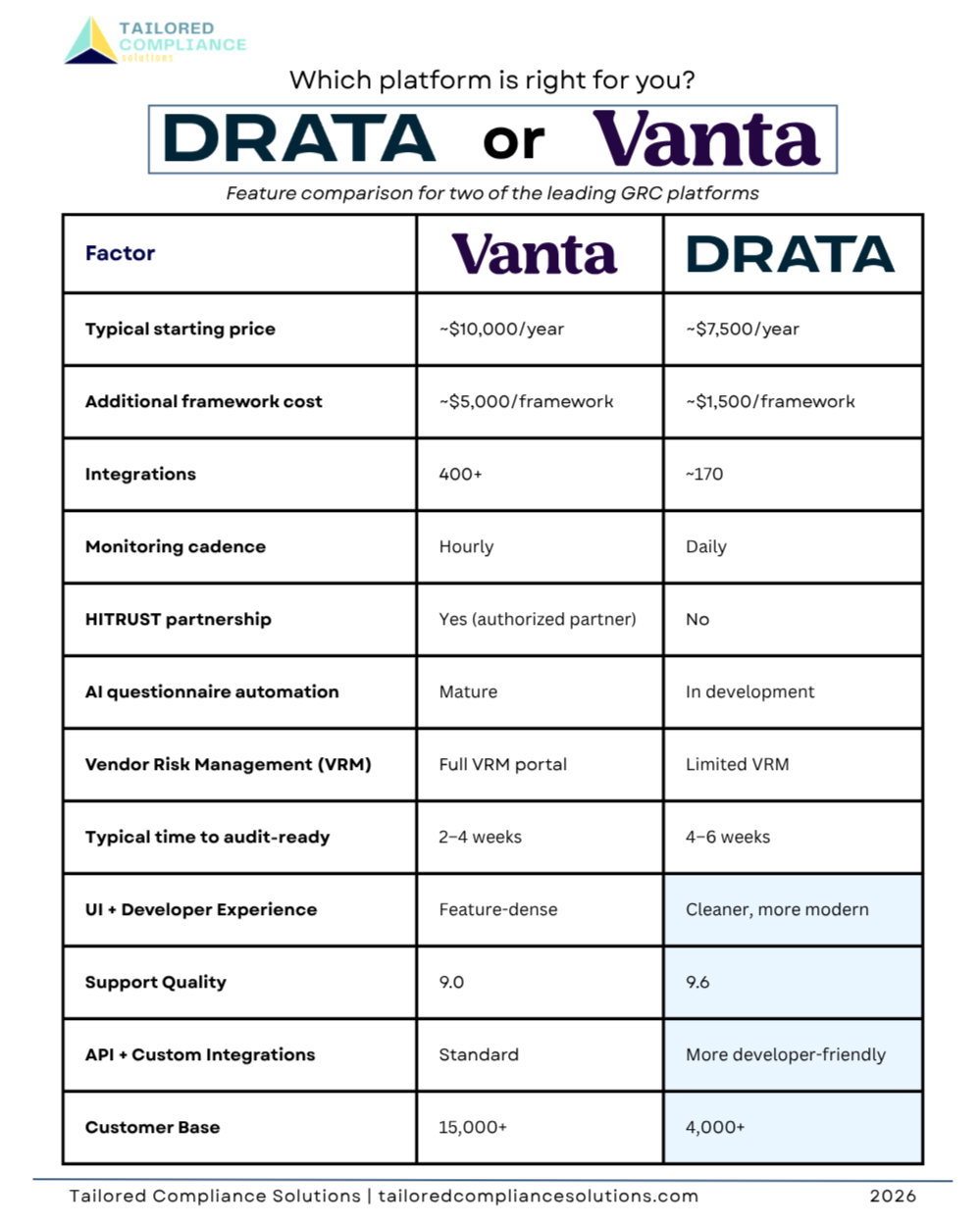
Two things to notice in this table that most comparisons downplay:
Drata's UI and support consistently score higher in third-party reviews. If your team is small, has no prior compliance experience, and values a clean onboarding path, that is a real consideration.
Vanta's integration breadth and automation maturity win on pure capability. If your stack is complex or you need to connect many SaaS tools, Vanta saves you manual configuration hours.
Both are true. Neither makes one platform universally better.
Situations where the choice is obvious
A few specific cases where we almost always recommend one over the other:
Almost always Vanta:
You are pursuing HITRUST now or within the next 18 months
You have enterprise customers actively sending you complex security questionnaires weekly
Your tech stack includes 20+ SaaS tools and you need automated evidence collection from most of them
Your compliance program includes meaningful vendor risk management scope
Almost always Drata:
You are planning 3+ frameworks in year one and per-framework cost matters
Your team is small, compliance is new, and UI clarity is a priority
You value dedicated, responsive customer support during implementation
You need a developer-friendly API for custom integrations with proprietary systems
Either works (pick based on pricing at the table):
You are a 10 to 50 person SaaS pursuing a first SOC 2 Type II
Your stack is the standard AWS + Okta + GitHub + Google Workspace setup
You have no immediate HITRUST or multi-framework plans
Your customer base is accepting of SOC 2 without pushing for deeper VRM or questionnaire automation
For that last category — which is where most TCS clients actually sit — the decision usually comes down to which one gives you the better first-year quote, and whether your implementation partner has deeper experience on one than the other.
What neither platform will tell you
A few things that do not show up in the vendor comparison pages but matter in practice:
Renewal pricing is where you get hit. Both platforms offer aggressive first-year discounts and then raise prices at renewal. Vanta customers on G2 and Reddit report 25 to 100 percent renewal increases. Drata has similar patterns. Lock in multi-year pricing if you can, or negotiate renewal caps into your initial contract.
The platform is not the program. Whichever platform you choose, someone still has to design your controls, collect and organize evidence the platform cannot auto-pull, manage the auditor relationship, and run the program day to day. Vanta and Drata are tools, not substitutes for a compliance owner. If your team does not have someone filling that role, the platform will not close the gap.
Switching later is possible but expensive. Migration typically takes 2 to 4 weeks of focused work. Both platforms support evidence export. Pick carefully the first time rather than planning to switch.
Neither platform will help you decide if you should be doing SOC 2 at all. That is a business conversation, not a platform conversation.
How TCS approaches platform selection
At Tailored Compliance Solutions, we are certified partners with both Vanta and Drata. That is a deliberate choice. Most boutique compliance firms partner with one platform because the process takes significant time and ongoing training. We made the investment in both because our clients' situations vary, and we wanted to be able to recommend either without a vendor relationship pulling us one direction.
What that means practically: if you hire us to implement your SOC 2 program, we will work through the decision flow above with your specific business, your current contracts, your growth plans, and your team's experience level. If Vanta fits better, we implement on Vanta. If Drata fits better, we implement on Drata. You get the right platform for your situation, not the one we happen to know.
If you are scoping your first SOC 2 and trying to decide between platforms, a gap assessment is usually the right first step. It takes about 10 hours of our time and produces a written findings report that includes a platform recommendation grounded in your actual business context. Book a gap assessment or see our full service list.
